zMed for Hospitals in Europe
The device layer and the decision layer your EMR is missing.
European hospitals already have an EMR. What they often lack is continuous device capture and decision support at the bedside. zMed supplies both — GDPR by design, resident in the EU, integrated over the standards you already run.
MDDI
Every bedside device, charted continuously.
zMed's medical device data integration connects directly to patient monitors, ventilators, infusion pumps, dialysis and anaesthesia machines — streaming numerics and native-rate waveforms into the chart in real time. Every value carries its timestamp, source device and bed association through a device registry that re-routes streams automatically on admission and transfer.
It is manufacturer-agnostic — 200+ devices and models across different manufacturers (see the full MDDI page) — brings legacy serial-port equipment online over small adapters, and replaces the separate device-integration middleware tier many hospitals still license — connectivity built into the clinical platform, not bolted beside it. Validated observations can feed your existing EMR over HL7 and FHIR R4, so zMed works as your device layer even where the EMR remains the system of record.
Clinical decision support
Hospital-owned rules, at the moment of decision.
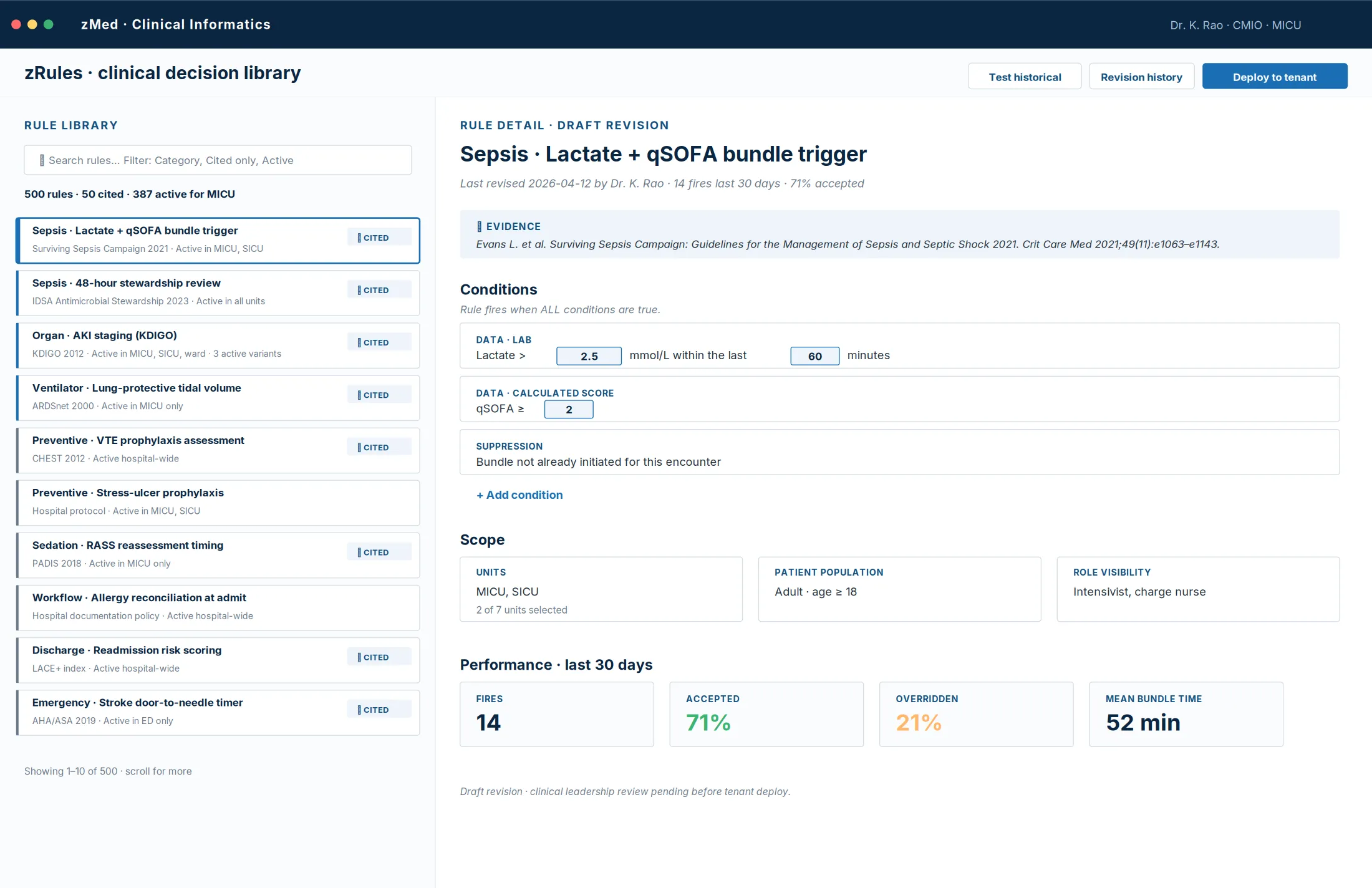
On top of the device stream sits a CDS substrate European quality teams can govern: ~500 rules at go-live (~50 literature-cited), twelve continuously recalculated clinical scores, care bundles run as timed state machines, and smart alarm management that cuts alarm load 60–85% through corroboration and override-pattern learning.
The library belongs to the hospital: a visual editor lets clinical leadership change thresholds, add rules and retire noisy ones — versioned, per-unit, with one-click rollback — and every fire, accept, override and defer lands in one audit log. All outputs are advisory, explainable and human-in-the-loop; final regulatory classification depends on intended use, deployment configuration, clinical claims, and jurisdiction.
GDPR & regulatory
European data, on European terms.
Privacy and regulatory discipline are properties of the platform, not paperwork added later — so your DPO and quality team evaluate architecture, not promises.
GDPR by design
Role-based access scoped by unit and shift, data minimisation in every workflow, encryption in transit and at rest, and protected health information redacted and de-identified before any cloud AI call. Patient data is never used to train shared or third-party models.
EU residency, your choice of topology
On-premises, EU-region sovereign cloud, or hybrid with the per-unit edge appliance — chosen per deployment so data stays where your DPO and national rules say it must. No cross-border flows by default.
Built for your DPIA
Data-flow documentation, processing-role clarity (zMed as processor, the hospital as controller), and a complete end-to-end audit log — clinician identity at every access, every override, every export — give your data-protection impact assessment an evidence trail rather than a questionnaire.
Honest regulatory posture
All clinical intelligence is advisory, explainable and human-in-the-loop — zMed makes no diagnosis, prescribes nothing, discharges no one. Final regulatory classification under EU frameworks depends on intended use, deployment configuration, clinical claims, and jurisdiction — and we work that assessment with your team, not around it.