zMed for Hospitals in the USA
Built for the standards your compliance team already enforces.
HIPAA-aligned controls by design, standards-based exchange with the systems you already run, and critical-care automation that pays for itself in clinician time.
Why US systems look at zMed
The night-coverage problem is structural. So is the answer.
Tele-ICU economics that work
One intensivist covering the network's sickest patients overnight — same chart, same orders as the bedside, one audit log across sites. Built for health systems with rural and critical-access hospitals to cover.
Fits the estate you have
Exchanges ADT, orders and results with your existing EMR, LIS and PACS over standard interfaces. Device integration is manufacturer-agnostic — the monitors and ventilators you own, as they are. No rip-and-replace.
HIPAA & security by design
Role-based access, end-to-end audit logging, encryption in transit and at rest, and PHI redaction before any cloud AI call. On the certification pathway, SOC 2 Type II is the active programme; HITRUST and FedRAMP follow as US deployments require them. Ask for current milestone status in your evaluation — we share dates, not adjectives.
Advisory Clinical AI
Designed with advisory, explainable, human-in-the-loop CDS principles — every suggestion shows its basis, every override is logged. Final regulatory classification depends on intended use, deployment configuration, clinical claims, and jurisdiction.
Audit workflows supported for TJC and ACHC accreditation regimes — security & compliance →
MDDI
Medical device data integration, built into the platform.
zMed's MDDI layer connects directly to bedside devices — patient monitors, ventilators, infusion pumps, dialysis and anaesthesia machines — and streams two kinds of signal in real time: numerics (vitals, settings, cycle metrics) and waveforms at the device's native sample rate.
Every value lands in the chart under a canonical observation code with its timestamp, source device and bed association attached — managed through a device registry that maps device → bed → patient, so an admission or transfer re-routes the streams automatically. It is manufacturer-agnostic — 200+ devices and models across different manufacturers — and legacy serial-port equipment joins over small network adapters. Device traffic terminates at the hospital LAN on the edge appliance, not at the cloud. The full MDDI story and supported-device list →
Modernise legacy middleware
A modern alternative to Capsule-class integration engines
Many US hospitals run a dedicated device-integration middleware tier — Philips Capsule and similar engines — with its own servers, licences and per-interface projects, whose job ends at moving data. zMed MDDI replaces that tier with connectivity that is part of the clinical platform itself: the same layer that captures the signal also charts it, scores it, runs the rules on it and audits it. During transition, zMed runs alongside the incumbent engine and takes over device families one unit at a time — your monitors, ventilators and pumps stay exactly where they are.
Feed your EMR
Connects to Epic, Cerner and other standard EMRs
zMed doesn't have to be your system of record to be your device layer. Validated device observations post to your existing EMR flowsheets over HL7 (ORU result feeds) and FHIR R4 (Observation and Device resources), while ADT flows inbound to keep patient-bed context synchronised. Epic, Cerner/Oracle Health, MEDITECH and other standards-based EMRs consume the feed like any results interface — so you get continuous device capture, waveform surveillance and smart-alarm intelligence without changing the EMR your clinicians document in.
Operating room · AIMS
Anaesthesia charting that writes itself.
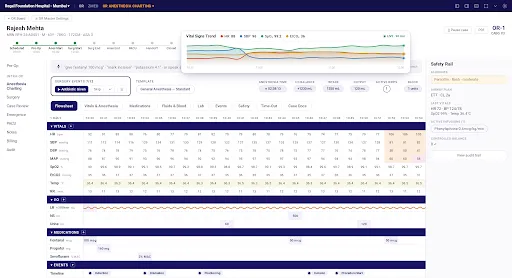
zMed's OR module is a full anaesthesia information management system: continuous trend curves for heart rate, blood pressure, SpO₂ and EtCO₂ captured automatically from the machines, the drug log timestamped below, and event markers — induction, intubation, incision — a single tap on the time axis.
A typical case carries ~140 chartable fields; the device-sourced majority is captured automatically, so the anaesthesiologist charts by exception. Pre-op check-in runs the surgical safety checklist as three recorded moments, the surgery list gives coordinators every theatre live, and the operative note, anaesthesia summary and recovery handoff draft themselves from the structured record at sign-out.
The OR module in detailDeployment
Your data, your boundary.
US-region cloud, on-premises, or hybrid with the per-unit edge appliance — the bedside chart survives network incidents, and patient data sits where your policies say it must.