HIS & ERP
One platform, not two systems
Registration, ADT, orders, pharmacy, billing and resource planning on the same record and audit log as the clinical chart.
1
database, audit log and report engine — clinical + administrative
100%
charges captured at source from the chart
0
re-keying between clinical and billing
What you get
Built for the unit, used by the clinician
- Registration, ADT & billing
- Orders, results & pharmacy
- Chart-driven charge capture
- Inventory, HR & finance
Overview
A hospital information system carries the operational weight of the hospital. Patient registration. Encounter records. Billing. Pharmacy dispensing. Lab worklists. Radiology orders. The administrative engine, the financial engine, the reporting engine. If the HIS goes down, the hospital stops. Most hospitals carry that weight on two systems — a clinical platform and an administrative one, stitched together with interfaces that break on every upgrade. zMed carries it on one. The clinical chart and the administrative record share one database, one audit log and one report engine.
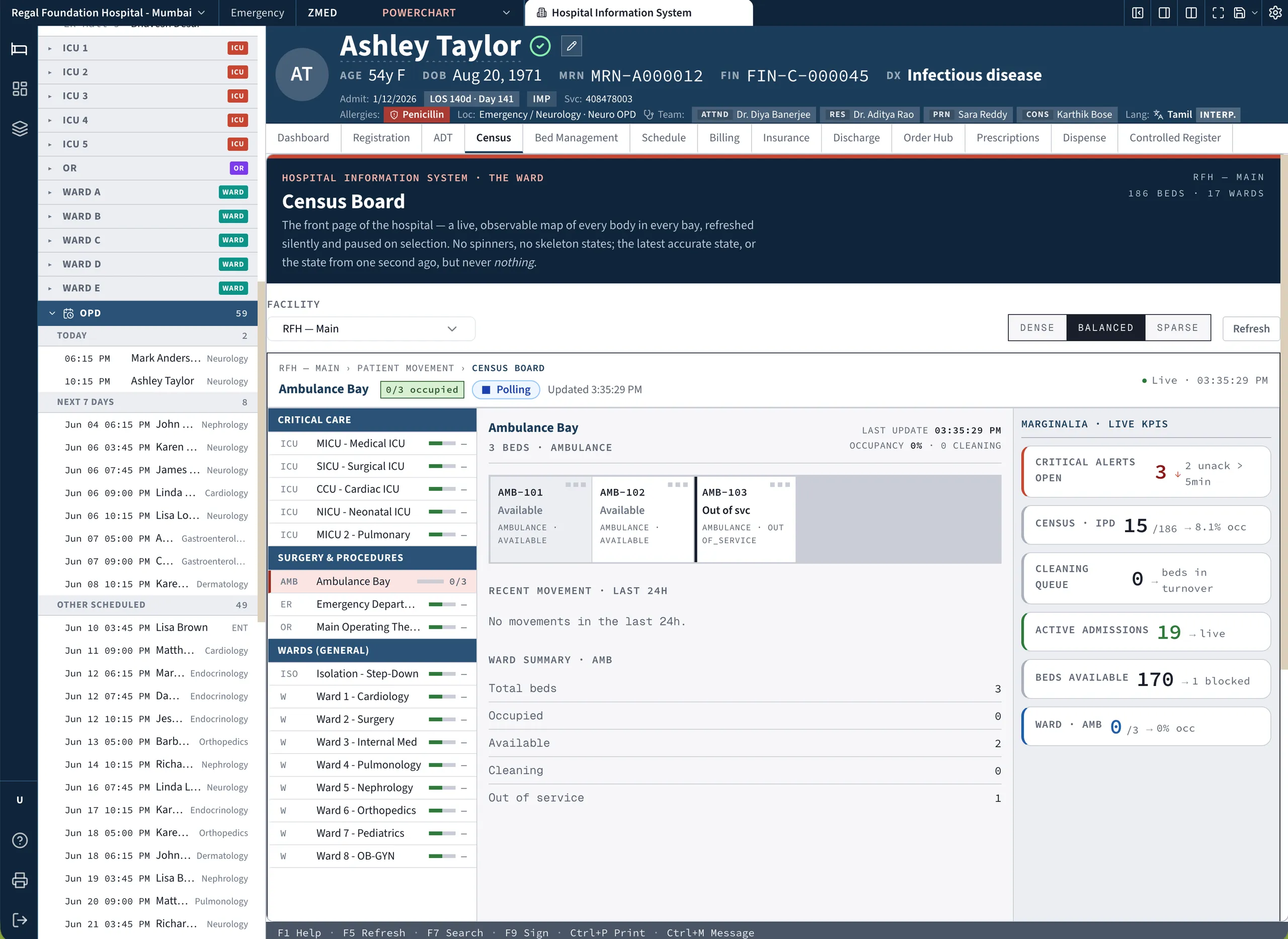
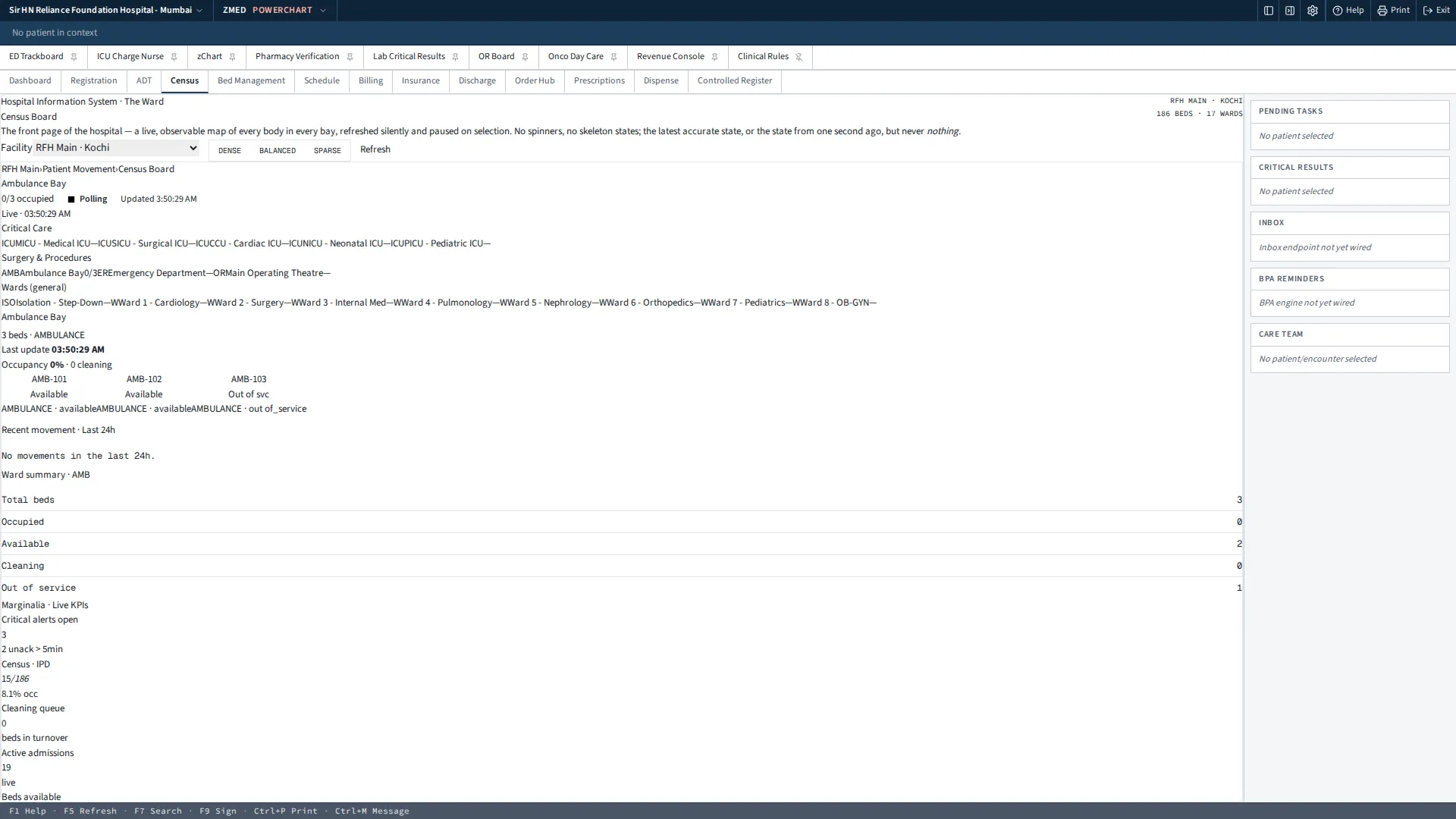
It begins at the front desk, the chart's starting line. Registration captures the patient — demographics, insurance, identity verified against the registry. Admission opens the encounter, transfer moves it to the right unit, and discharge closes the chart, each transition a single audit-trailed action that fires the right downstream workflow. The linkage is absolute: every clinical record links to the encounter, every encounter to the patient, every patient to one identity across the hospital. The same chart engine that drives the inpatient bedside drives the outpatient visit, so a walk-in, a scheduled consult, a follow-up or a refill is documented at the cadence each needs, with the patient's full history visible at every visit.
From there, the chart becomes the hospital's nervous system. A prescription written in the chart drops into the pharmacy queue the moment it is signed; the pharmacist dispenses with stock levels visible and substitutions flagged, and daily reconciliation surfaces any gap between dispensed and administered. A lab order lands on a live, prioritised worklist; results return to the ordering clinician the instant they are released, abnormals flagged. A radiology order becomes the modality's worklist, and the report lives in the chart rather than a separate web page, with the image one tap away.
Billing does not re-enter any of this. The billing engine reads the chart and applies the hospital's rules, turning every order, dose, procedure and consult into a charge captured at source. Pre-authorisation is built into the admission, insurance status is visible on the chart, and the patient's statement is one document — every disputed line traceable back to the entry that drove it.
Beneath the clinical layer runs the full ERP backbone on the same platform: stores with inventory, purchase orders and suppliers; HR with roster, payroll, leave and performance; finance with the general ledger, budgets and financial reports — all drawn from one data layer and one audit log. Reporting closes the circle. Clinical, operational, financial and compliance reports are template-driven and audit-linked, schedulable or produced on demand for the board, with every figure tracing back to the chart entry it came from. The hospital configures the templates, rules and workflows itself, and the platform's built-in intelligence summarises notes, drafts reports and flags discrepancies inside the workflows the team already uses. The hospital does not run on two systems. It runs on one.
Explore more
Other modules & products
ICU & Critical Care
Every bedside signal, read every minute
Tele-ICU & Command Center
One specialist, every bed, every site
Operating Room & Anaesthesia
The chart that writes itself
Emergency & Triage (ER)
The pathway opens at the door
Ambulance & Pre-Hospital
Care that starts before arrival
Clinical Decision Support (Comprehensive)
Guidance where the decision is made
Clinical AI (Comprehensive)
“Is this about to happen?”