Ambulance & Pre-Hospital
Care that starts before arrival
Nearest-unit dispatch, field charting on the device the crew already carries, and a chart that reaches the ED before the patient does.
1
record per case, from first call to hand-off
Live
fleet map with computed ETA, shared to the ED
Pre-arrival
STEMI, trauma, stroke and sepsis activation
What you get
Built for the unit, used by the clinician
- Nearest-unit dispatch
- Field crew charting
- Streaming pre-arrival vitals
- Live fleet map & ETA
Overview
Pre-hospital care is the most operationally challenging part of a hospital's reach. The crew is mobile, the case is unknown until arrival, the documentation happens on a phone in motion, and the hand-off to the receiving department has to be one continuous record — not a verbal summary in a hallway. zMed's ambulance module collapses that fragmentation into a single platform that runs from the first call to the moment the patient passes through the emergency department doors.
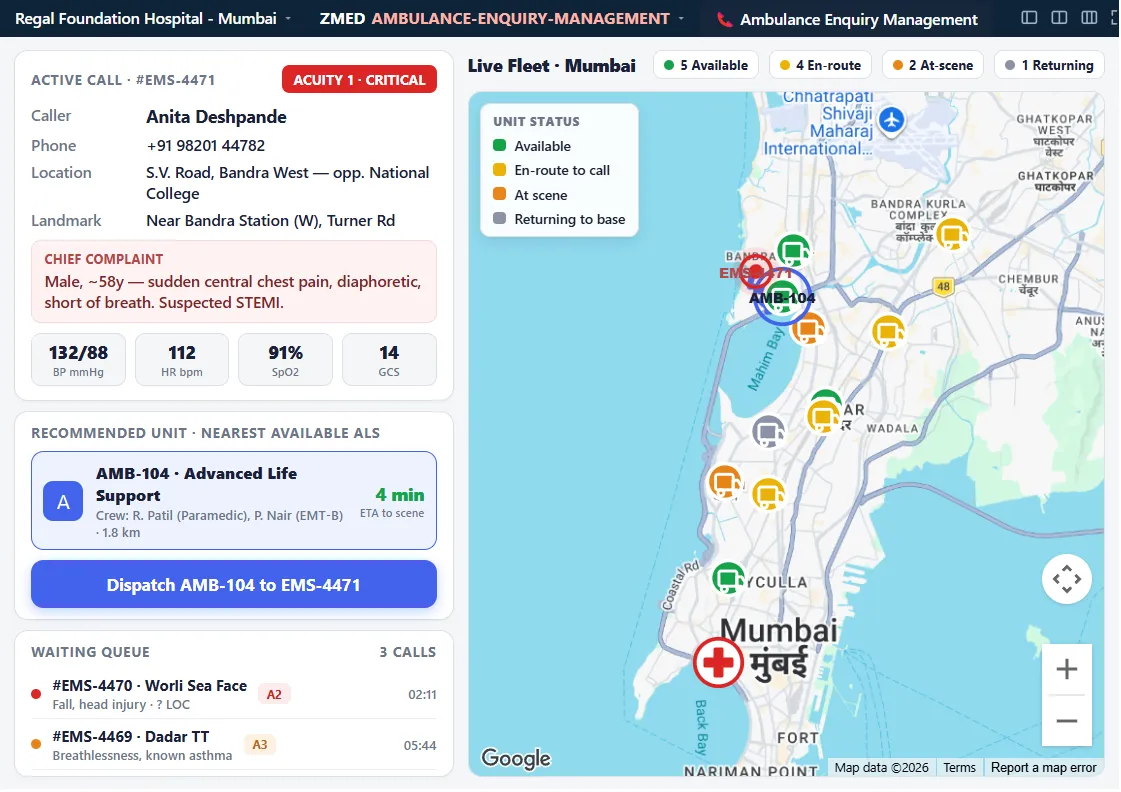
It starts at enquiry. The call arrives and the case is captured in seconds — caller name, callback number, location, complaint and acuity. The dispatcher sees the closest available unit on a live map, and a case-type filter narrows the view to only those units carrying the right capability for the case. Dispatch is one action: select the unit, send the case, and the crew app receives it instantly. The fastest dispatch is the one that never makes the dispatcher switch between a phone, a paper log and a map — so the console combines all three into a single screen built for the cadence of the call.
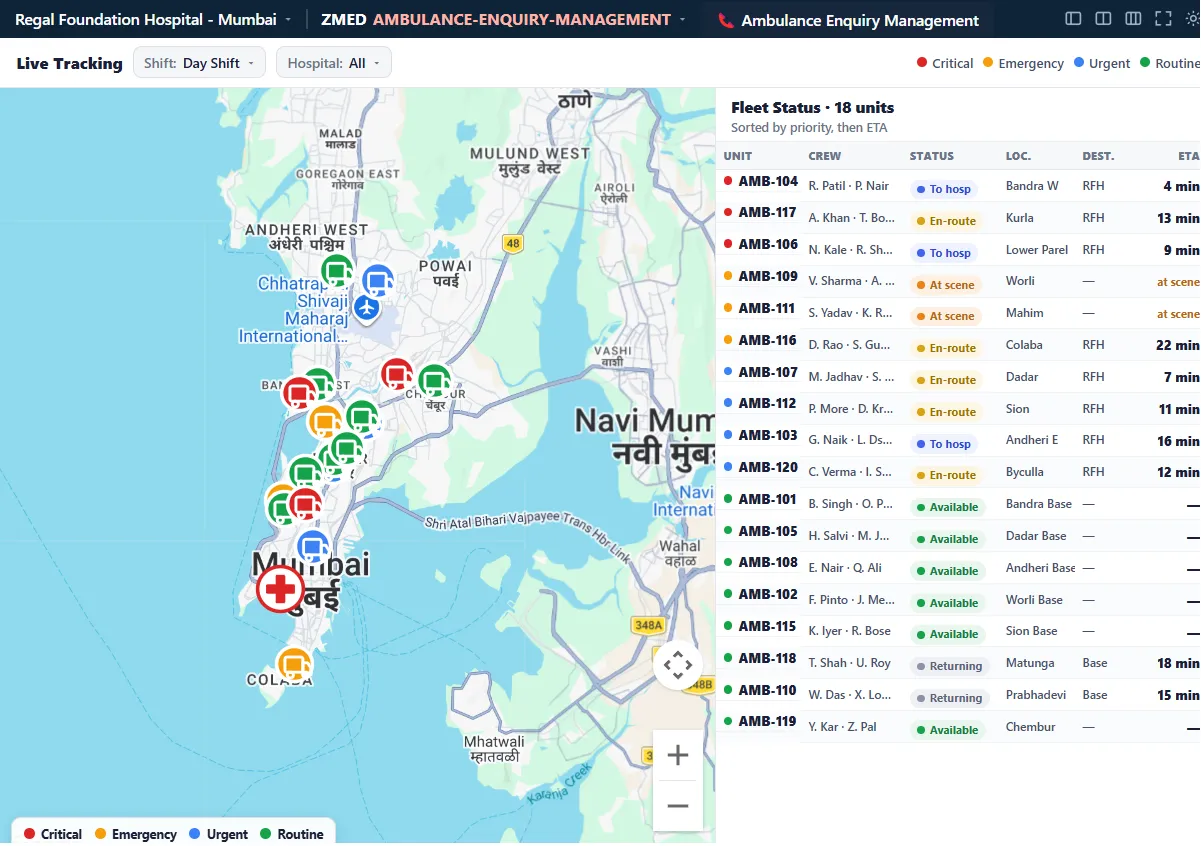
Once a unit is moving, the live map becomes the operations dashboard. Every ambulance, every status — available, en route, at scene, transporting, at destination, returning — and every computed ETA is visible to dispatch and to the destination hospital. When the hospital chooses to share it, the ETA reaches the family as a simple message, turning anxious waiting into reassurance.
In the field, the crew charts on the phone or tablet they already carry. Vitals — heart rate, blood pressure, SpO₂, GCS, blood sugar — are entered fast and charted live. Interventions are logged in the moment and audit-trailed: drugs given, devices used, manoeuvres performed. Observations are captured by voice while the crew's hands stay on the patient. Crucially, the chart streams to the receiving emergency department while the ambulance is still en route — which is what makes pre-arrival activation possible. STEMI, trauma, stroke and sepsis pathways can be activated before the patient ever arrives, so the receiving team is assembled and ready at the door.
That continuity defines the hand-off. The patient arrives with the chart already in place; the triage nurse opens the chart, not a sheet of paper. The clinical hand-off becomes what the crew tells the team — not what the team has to type in. A management dashboard rounds out the picture, surfacing active cases by acuity and region, mean and 95th-percentile call-to-dispatch and dispatch-to-arrival times, and unit utilisation per shift, all drawn live from the system. The result is one record per case, from the moment of dispatch through arrival to hand-off — care that genuinely starts before arrival.
Explore more
Other modules & products
ICU & Critical Care
Every bedside signal, read every minute
Tele-ICU & Command Center
One specialist, every bed, every site
Operating Room & Anaesthesia
The chart that writes itself
Emergency & Triage (ER)
The pathway opens at the door
HIS & ERP
One platform, not two systems
Clinical Decision Support (Comprehensive)
Guidance where the decision is made
Clinical AI (Comprehensive)
“Is this about to happen?”